Its Time to Drench the Sheep Again So Chance and Chelsalou Are Fencing Off a Large Rect
Shoddy fences? Accidents will happen!
Information technology'southward bound, and that means livestock returning to pasture afterwards a long, dreary winter on slats. All besides often, information technology also means livestock escaping from said pasture. Driving to piece of work on these well-baked, clear March mornings, I've come close to collision with several ewes grazing blithely forth the roadside, lamb at heel.
Now I sympathise with all farmers when it comes to the constant struggle to go along animals bars. Sheep, in particular, are notorious for testing every section of fencing; and we all accept that one ewe who finds the grass a scrap sweeter on the other side.
But those of us with livestock need to be careful, too. As farmers we shouldn't forget that maintaining good fences is our responsibility. The road is no place for animals to graze. For all their ingenuity as escape artists, sheep and cattle have no understanding of the rules of the road. When we neglect to go on them out of public spaces, nosotros put motorists and other road users in danger. We also run the take a chance of harsh legal penalties that most of us would rather not incur.
On the upside, it's not too hard to put upwardly a argue that will go along even the most audacious animals confined to the paddock. There are plenty of excellent fencing contractors who will make sure that your fields are sheep-proof and cow-proof this twelvemonth. Just if you'd rather avert the expense of hiring a professional person to do the job, putting upwardly your own debate is relatively straightforward. It but takes time, sweat, and a small-scale corporeality of know-how.
To help you along, we at Agridirect have compiled a 10-footstep guide to erecting your ain sheep contend. With this easy-to-follow fencing guide, you can be certain your woollies won't be pulling off whatever nifty escapes this bound.
What you'll need:
If you're planning to put up a sheep wire fence with 2 rows of barbed wire on top, y'all should assemble the following items earlier you lot get started: i Post driver, 1 crowbar, 1 pliers, iv wire pullers, 1 easy wire puller, 1 wire roller, i bong hook, 1 chainsaw, i hammer, staples, gripples, 1 gripple contractor, 1 role of polyrope (optional), several rolls of 3ft sheep wire, at least 2 rolls of barbed wire, steel wire for tying, a 5ft post for every 4m of contend, 7ft straining posts for corners and precipitous bends.
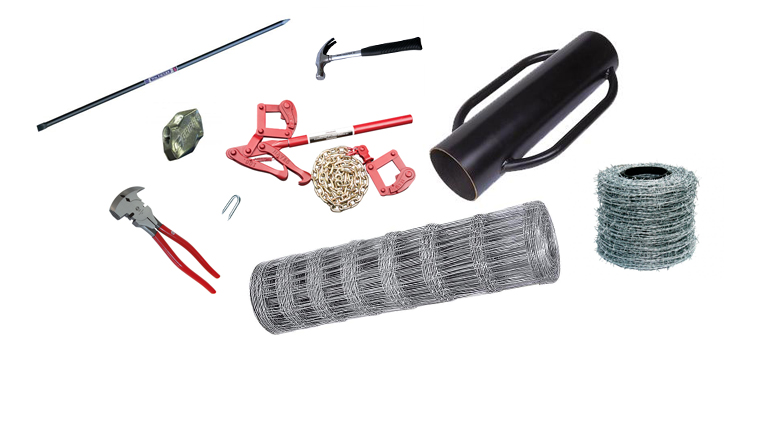
10 Steps:
1.Clear your fenceline:
So you have all of your equipment together and you're continuing out in the field, assessing the task ahead. Swell. It's fourth dimension to clear the fence line. If the boundaries of the field are thick with bushes or thickets of brambles, y'all should cut these back, using a bong hook and a chainsaw as the need arises. This may seem similar actress and unnecessary endeavour; but trust me, it'southward not. Yous don't want brambles growing on your argue, or branches falling onto it, just weeks after you put it up!
2.Stand your straining posts
One time the argue line is cleared, information technology'due south time to prepare your 7ft straining posts. These are the heavier posts that you will employ for corners and any other curve in the fence where the wire is probable to put force per unit area once information technology is pulled tight. If you are fencing a small, square field with very straight sides, you may but need 5 or 6 of these. But if your fence is long and crooked, y'all volition demand a lot more than. Make pilot holes for your straining posts using a crowbar, and place the posts into the pilots. Drive these with your mail driver until roughly 4ft remains above ground. At this point it should be very secure, unless you are driving it in swampy ground.
Be very careful when using a mail service driver. Brand certain that the lip of the driver doesn't come "off the elevation" of the mail service as you elevator. The force of your downward thrust will impel your caput forrad and your forehead will crack against the metal cylinder. If the straining posts are too large for the post driver, you should drive them using a digger.
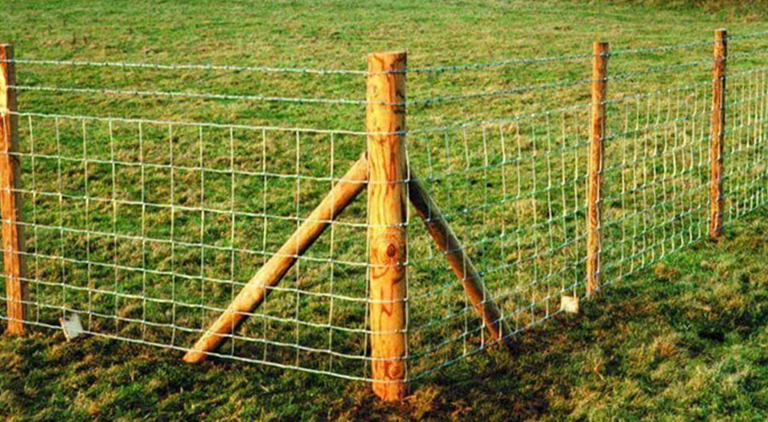
3. Secure your straining posts
Once you're satisfied that your straining posts are deep enough, you should prop them with bracing struts at an angle of fifty or 60 degrees (see case above). Brand sure the base of the strut is secure in the ground, and that the top is fitted into the strainer post, by cut out grooves for them. Secure the tiptop of your struts by nailing them on. You should as well tie the strainers back with tying wire. Look behind the mail service (i.due east. outside the debate line). If there are any sturdy copse close to the straining postal service, yous can necktie it back to ane of these. If not, y'all should drive a 5 ft postal service at a 60-degree angle a couple of feet behind the strainer and in line with the fence, and tie to the base of this instead. When making your necktie-back, be sure to pull the tying wire tight, using a pliers. Once it is taut, staple the wire at the crown of the straining post and the butt of the tie-back post to hold in place.
iv.Establish a directly line between straining posts
Now that your straining posts are upwards and fully immobile, information technology's time to get your debate line sorted. At this signal in the project, it's best to work section by department. In other words, y'all should fence from ane straining post to the adjacent, and get that department of fence finished, before moving onto the next stretch. If y'all want an arrow-direct contend, run some polyrope from 1 straining post to the next and pull information technology tight. The polyrope, like the argue, should run off the inside of the offset straining post, and the outside of the side by side one (i.e. the corner post).
5.Make pilot holes and stand up posts
In one case the line running between your straining posts is directly, walk along information technology with your crowbar. Every 4 metres, brand a airplane pilot pigsty backside the rope. Stand up a 5 ft mail in each pilot hole.
six.Pound posts with a post driver
One time your posts are standing in their pilot holes, roll upward the polyrope and take a breather. The work is about to get physical. Using your post driver, pound all of your 5 ft posts appox. 1ft into the basis. Don't be too proud to take regular breaks, specially if the ground is dry out and the soil compact. Using a mail driver is one of few occasions when farmers with bad land have cause to rejoice! (Notation: if the fence line runs into a hollow, drive a mail service in the hollow and tie it back using steel wire, as with your straining posts. This will preclude it from "popping upward" under the pressure level of the taut wire. Drive a mail on either side of the hollow, besides. When you are pulling and stapling (steps 8 and 9) you should leave the pull loose enough for the wire to be forced down and stapled onto this post. Staple the posts either side of the hollow offset, and then pull the wire downwards onto the hollow post, using your human foot if necessary. Staple the lesser strand starting time.)
7.Tie on wire and roll out
If you're nevertheless on your feet after this ordeal, bind your 3ft sheep wire to the start straining post past wrapping it effectually it. This process is much trickier for sheep wire than for barbed wire. Yous have to remove all of the vertical bars from the first few squares of the scroll with your pliers. Then you lot can loop each of the horizontal wires around the mail service and back onto themselves. Staple each strand of the looped wire to the straining post to secure it. Once this is done, you lot can curl out your wire on the within, or field-side of your debate posts. If there are any minor bends in the fence line, take the wire "outside" the post that will take the force per unit area. Because sheep wire comes in shorter rolls than spinous wire, you will have to join rolls oftentimes. You can practise this by connecting the horizontal wires to each other with gripples. Again, you may have to cut off a couple of sections of the vertical bars with your pliers to do this.
8.Pull the wire to the "side by side" straining mail
When you accept rolled out equally far as the corner straining post, have the wire around the back or "outside" of information technology. Y'all are going to pull the wire to this mail service. Using loops of steel wire, attach two wire pullers to the strainer post at the top that you want the top and bottom strands of your sheep wire. Employ a pull to the bottom strand of the sheep wire first, until the wire comes tight to the fence line. Then put a pull on the summit strand. At this point, the wire should be standing up along the argue line.
9.Staple wire to posts
Motility along the argue, stapling the summit, bottom and middle strands to each post at the desired height. E'er staple the summit strand outset, lifting it if necessary. Brand sure there are no "numberless" in the wire when you lot staple. In one case all posts are stapled, render to the straining postal service. If there is still whatever sag on the acme and bottom strands of sheep wire, use another pull before stapling onto the strainer, using a pliers to pull the wire tight. With your like shooting fish in a barrel puller, pull the centre strands of the sheep wire tighter and staple to the post as well.
10.Repeat for spinous wire, then repeat steps four-10
Repeat this process for two strands of barbed wire, which should exist tied and stapled to the posts iv and 8 inches higher up the sheep wire. It is advisable to roll the barbed wire on the exterior of the fence line and lift information technology in afterwards. This will prevent it from sticking to the sheep wire as it is tightened. Once the spinous wire is on and stapled, motion to the next section of the fence and repeat steps iv to 10.
And that's a wrap!
So that's information technology for this calendar week'south get-go blog entry. If you're new to fencing, requite our 10 Stride Sheep Debate a become and let us know how you get on.
Perhaps some of y'all more than experienced farmers and fencers have good advice on ways to improve on our fencing guide. If then, please allow us know your thoughts! We would be delighted to include any useful pointers in an updated version of this blog.
And remember, folks. Good fences brand for good neighbours; merely they also brand for safer roads, and fewer legal scrapes.
MPG
Note: Thanks to my Dad, Mick Geoghegan, for advising me on this. Dad is a retired fencing contractor, with 30 years of feel in the field(s)! Continue an middle out for our full interview with him, which volition exist published on the Agridirect weblog in the coming weeks.
For more keen content as well as the latest offers, be sure to check us out on Facebook and Twitter.
Source: https://www.agridirect.ie/article/our-guide-to-a-sheep-proof-fence
0 Response to "Its Time to Drench the Sheep Again So Chance and Chelsalou Are Fencing Off a Large Rect"
Post a Comment