Iwill Be With You Again Song
| "When Will You Return?" | |
|---|---|
| Vocal by Zhou Xuan | |
| Language | Chinese |
| Released | 1937 (1937) |
| Composer(due south) | Liu Xue'an ( 劉雪庵 ) |
| Lyricist(s) | Huang Jiamo ( 黃嘉謨 ) |
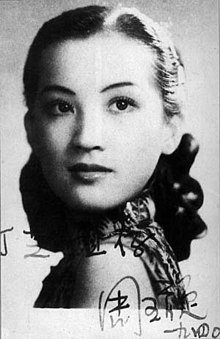
"When Volition Yous Render?" (Chinese: 何日君再來; pinyin: Hé Rì Jūn Zài Lái ) is a Chinese song first sung by Zhou Xuan in 1937, but also well known every bit a vocal by Teresa Teng. It has besides been variously translated every bit "When Will the Gentleman Come up Back Once again?" or "When Will Y'all Come Back Once again?" The lyrics were written by Huang Jiamo ( 黃嘉謨 ) ready to a tune composed by Liu Xue'an.
Background [edit]
Composition [edit]
Co-ordinate to Liu Xue'an'southward son, the tune was written by his father at an undergraduate political party at the Shanghai Music Solarium, during which an impromptu vocal-limerick contest was suggested. Liu wrote the melody quickly, played it every bit a tango vocal and won the approval of other students.[1] The director Fang Peilin (d. 1949?) liked the tune, and asked Bei Lin (later identified as Huang Jiamo) to write the lyrics to exist used for his new flick.[2]
Controversy [edit]
The vocal was highly popular also as controversial. The controversy arose due to the various interpretations and political readings of its supposed "hidden" significant. The lyrics were interpreted as either anti-Japanese, treasonous, or pornographic. After 1949 the vocal was banned by the People's Republic of Communist china because information technology was seen as conservative and decadent.[3] [4] The writer Liu was criticized and suffered during the Anti-Rightist Motility in 1957 and during the Cultural Revolution in the 1960s. He offered a public self-criticism in 1980 before he was rehabilitated, but criticism of the vocal continued in mainland China for some time as an example of "Xanthous Music", a product of decadent and immoral gild.[3]
Zhou Xuan'due south original version [edit]
The song was originally sung by Zhou Xuan and get-go appeared equally an accompaniment to the picture Three Stars by the Moon ( 三星伴月 ), a 1937 film directed by Fang Peilin and produced by the Yihua film company. The film was one of the last silent movies fabricated in Mainland china, and the just silent movie Zhou Xuan starred in. The songs in the film were probably played to the audience on a gramophone synchronized with the activity.[5]
Teresa Teng's version [edit]
The song became heavily associated with Teresa Teng through her version, first released on her 1978 "A Dear Letter" album,[6] so much that she has supplanted Zhou Xuan as "the primary singer identified with this song".[7] In Red china likewise, Teng became prominent via the song. Geremie R. Barmé, writer of In the Red: On Contemporary Chinese Civilization, described the song every bit a "nostalgic ode". Barmé said that some individuals on the Mainland condemned the song, describing it as "traitorous" and "obscene".[8]
Memorials for Teng have included performances of "When Will You lot Return?"[9]
Other versions [edit]
Zhou'south colleague, actress Li Lili performed the song in Cai Chusheng's film Orphan Island Paradise 孤島天堂 (1939).[10]
The song was translated into Japanese and sung by Hamako Watanabe (1940), and was re-released by Li Xianglan the following year; Li (aka Yamaguchi Yoshiko) was fluent in both Chinese and Japanese, and too performed Chinese versions.[eleven]
The vocal has been recorded by Judy Ongg,[12] Fei Yu-ching, Lisa Ono, Claire Kuo and many others.[ citation needed ]
Mitsuki Takahata sang it every bit the title track to the moving picture Itsu mata kimi to (2017).[12]
A rendition entitled "Waiting for Your Render" by Jasmine Chen and bundled past Christopher Tin played during the opening credit of the film Crazy Rich Asians (2018).[13]
References [edit]
- Citations
- ^ Steen (2000), p. 139, citing Zhu Tianwei (1990), p. 231
- ^ Steen (2000), p. 139, citing Zhu Tianwei (1990), pp. 230–231
- ^ a b Steen (2000), pp. 124–153.
- ^ Jones. Andrew F. (2001). Yellow Music - CL: Media Civilization and Colonial Modernity in the Chinese Jazz Historic period. Duke Academy Press. pp. 151. ISBN0-8223-2694-9.
- ^ Steen (2000), p. 129–130.
- ^ "一封情書 - Teresa Teng'due south Discography". iteresa teng (Teresa Teng'southward Discography) (in Traditional Chinese). Retrieved 9 January 2022.
映期: 1978年12月21日
- ^ Steen (2000), p. 146.
- ^ Barmé, Geremie R. (1999), In the Red: On Contemporary Chinese Culture, Columbia University Press, p. 125, ISBN9780231106146
- ^ "Shanghai embraces fresh Chage & Aska". mainland china.org.cn. Retrieved 2012-03-fourteen .
- ^ Steen (2000), pp. 126. 134.
- ^ Steen (2000), p. 135.
- ^ a b "Takahata Mitsuki, Shōwa kayō no meikyoku wo kabā: Mukai Osamu no hanseiki 'Itsu mata kimi to' shudaika" 高畑充希、昭和歌謡の名曲をカバー 向井理祖母の半生記『いつまた、君と』主題歌 [Mitsuki Takahata covers classic vocal from Shōwa period: title rail of Its mata kimi to, a biography of Osamu Mukai's grandmother]. Oricon News. 2017-03-09.
- ^ Witzleben, J. Lawrence (15 July 2019), "Transnationalism and Transformation in the Songs of"Crazy Rich Asians"" (PDF), Abstracts for the 45th ICTM Globe Briefing, p. 209
- Bibliography
- Steen, Andreas (2000). "Tradition, Politics and Meaning in 20th Century China's Popular Music: Zhou Xuan — When Volition the Gentleman Come Back Once again" (PDF). CHIME Journal (14–xv): 124–53. Archived from the original (PDF) on 2013-05-02.
- Zhu Tianwei 朱天纬 (1990). "Guanyu 'Heri jun zailai' de qianqian houhou 关于〈何日君再来〉的前前后后 [Everything virtually "When will the gentlemen come back once again?]". Zhou Xuan gequ 100 shou 周璇歌曲100首 [Zhou Xuan: 100 songs] (in Chinese). Taiyuan: Shanxi jiaoyu chubanshe.
External links [edit]
- "When Will You Return?" on YouTube
Source: https://en.wikipedia.org/wiki/When_Will_You_Return%3F
0 Response to "Iwill Be With You Again Song"
Post a Comment